Abstract
What if instead of humans we send robotic vehicles to monitor dangerous environments? IntelliGuard is an AI-powered intelligent security platform designed to detect, analyze, and respond to cyber and physical threats in real time using advanced machine learning and computer vision technologies.
- The rapid advancements in ubiquitous computing have made surveillance robots vital in military and security systems. IoT and sensor miniaturization enable new autonomous monitoring capabilities where traditional fixed installations or human operators prove ineffective. IntelliGuard, an ESP32-based IoT surveillance robot, integrates camera streaming, motor-driven navigation, and centralized processing for military applications. The system provides autonomous mobility, real-time surveillance, and secure data transmission while remaining cost-effective. Radar and ultrasonic sensors enable precise obstacle detection within three meters.
- Field testing revealed performance variations under different environmental conditions, with optimal functionality in low-interference settings. Response latency remains minimal while IoT connectivity enables remote operation. Performance directly correlates with sensor precision and connection quality.
- Future developments will focus on more accurate sensors, stronger communication protocols, improved navigation for irregular obstacles, and enhanced filtering algorithms to minimize interference effects. This study establishes a foundation for advanced IoT-connected robotic surveillance systems in military applications.
Similar to companies developing advanced robotic systems, engineers working on autonomous robotics need to consider:
- Which algorithm to use to build the model.
- How large the model should be.
- How to obtain relevant data to build the model.
IoT-Driven Multi-layered Security Framework for Real-Time Threat Detection and Adaptive Response
AI-powered IoT security platform enabling real-time surveillance, anomaly detection, and intelligent threat identification using edge computing and cloud analytics.
Automated threat response with secure encrypted communication, instant alerts, remote device management, and predictive risk assessment for proactive security.
Scalable multi-layer architecture featuring sensor fusion, adaptive power management, and seamless integration with existing enterprise and critical infrastructure security systems.
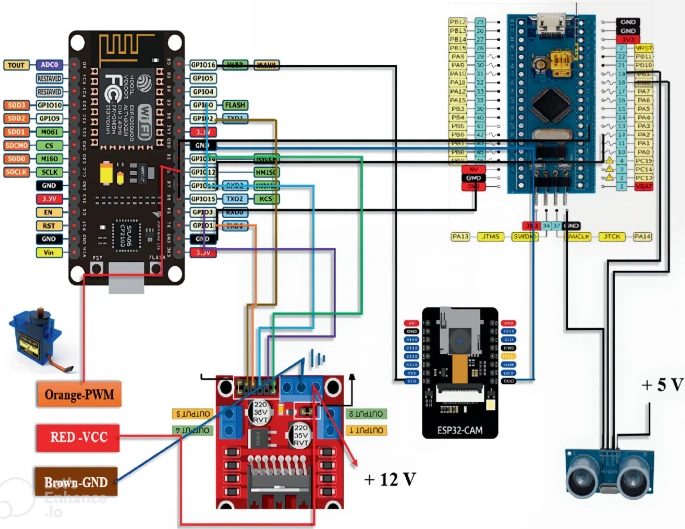
System architecture of IntelliGuard Ver. 2 showing full system communication data-flow from radar/ultrasonic sensors to GUI with proper integration.
IoT-Enabled Surveillance System Implementation and Workflow
IntelliGuard combines embedded systems, sensor processing, communication, and autonomous surveillance capabilities into an integrated robotic platform.
- Autonomous AI Spybot designed for real-time surveillance, reconnaissance, and threat detection in extreme environments such as military operations, disaster response, mining, and space exploration.
- Intelligent navigation system combining ESP32, radar, ultrasonic sensors, and computer vision for 180° obstacle detection, autonomous movement, live video streaming, and remote monitoring.
- Modular IoT architecture featuring secure Wi-Fi communication, real-time sensor processing, remote control, and scalability for future edge-AI-powered autonomous decision-making.
The architecture is designed to support future integration of advanced AI capabilities for autonomous decision-making and environmental awareness.
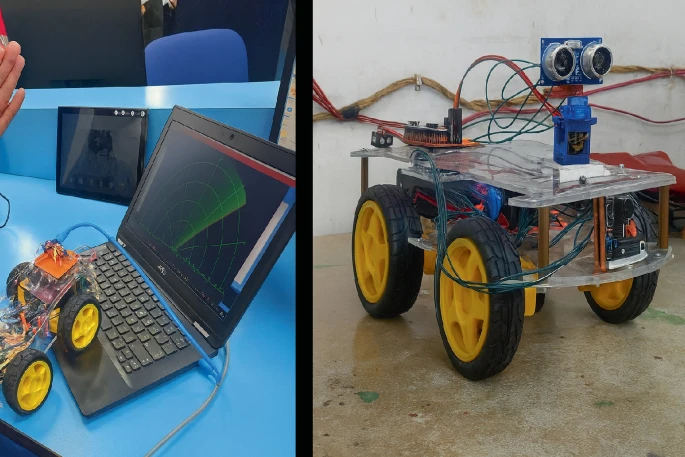
Prototype of an autonomous spybot designed for object detection, angular and distance estimation within a 180° navigation field, featuring dual parameter red/green indicator system and remote surveillance capability for rescue and reconnaissance operations.
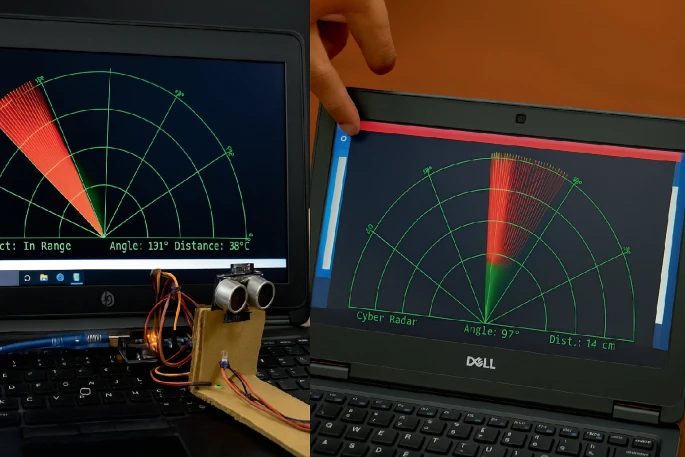
System workflow for autonomous surveillance and rescue operations.
Results and Discussion
High-performance autonomous surveillance system achieving approximately 92% obstacle detection accuracy, 250 ms response time, real-time radar visualization, and secure remote monitoring via ESP32 and private IP communication.
Built for Mission Critical Environments including military reconnaissance, disaster response, borewell rescue, mining, industrial inspection, and hazardous-area surveillance, reducing human exposure to life-threatening conditions.
The platform is designed as a future-ready AI robotics system with planned integration of LiDAR, SLAM, edge AI, and machine learning-based sensor fusion to enhance autonomous navigation, localization, and decision-making in dynamic environments.
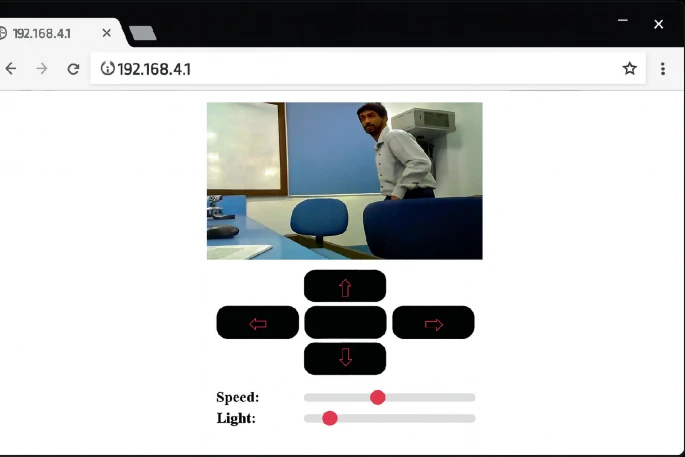
Designing GUI interface on tablet to remotely control the systematic model through private IP communication.
Conclusions and Future Direction
The IntelliGuard surveillance robot represents an important step forward in IoT-enabled autonomous monitoring systems that offer considerable advantages over conventional surveillance methods in mobility, security, and real-time adaptability.
Further validation through large-scale field trials and detailed comparisons with existing systems will enhance its practical impact and provide a more concise appraisal of its benefits for real-world applications.
Future work will involve field testing in diverse environments, integrating AI-based decision systems, and benchmarking against other surveillance technologies. LiDAR can be used for fine-grained depth sensing, while SLAM techniques can allow IntelliGuard to operate in GPS-defined zones.