Abstract
Artificial intelligence and computer vision are creating new opportunities for automated sports analysis. Tennis footage can be challenging to interpret computationally because of fast player movement, small objects such as tennis balls, changing camera perspectives, and complex court interactions.
The chapter Build an AI/ML Tennis Analysis System with YOLO, PyTorch, and Key Point Extraction explores a computer-vision approach to tennis analysis using modern deep-learning tools. Its stated technical focus brings together YOLO-based object detection, PyTorch-based model development, and keypoint extraction to support the interpretation of visual information from tennis footage.
These methods can form components of a sports-analysis workflow: detecting relevant objects, representing spatial information, and visualizing model outputs. Practical performance depends on the selected models, available data, video conditions, and appropriate evaluation.
Research Overview
The research topic examines how AI and machine learning can make tennis video analysis more systematic and computationally assisted. A computer-vision pipeline can process recorded footage and extract visual information that may help analysts review a tennis scene.
Object detection, deep learning, and keypoint extraction serve complementary purposes. Detection can identify objects of interest, while keypoints can represent selected spatial landmarks. Together, these outputs can provide a structured view of a scene for further analysis.
Research Objectives
The chapter's technology focus can be organized around the following objectives:
- Object detection: Explore YOLO-based approaches to locating and classifying relevant objects in tennis footage, depending on the selected model and its trained classes.
- Deep learning: Examine PyTorch as a framework for implementing, training, loading, or evaluating models used in computer-vision tasks.
- Keypoint extraction: Represent selected spatial landmarks, such as body joints or court points, according to the chosen keypoint or pose-estimation method.
- Visual interpretation: Organize model predictions into overlays and structured visual outputs that can be reviewed by a human analyst.
- Pipeline integration: Consider how video processing, object detection, and spatial information extraction can be combined into an AI-assisted workflow.
Technical Methodology
1. Video Input and Frame Processing
Recorded tennis footage can be processed as a sequence of frames. Depending on the implementation, frames may be sampled, resized, and preprocessed before being passed to a computer-vision model.
2. YOLO-Based Object Detection
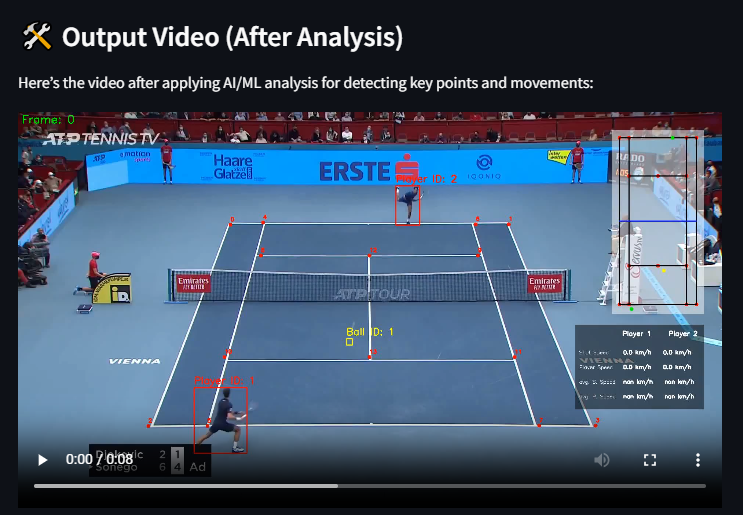
YOLO is a family of object-detection models designed to locate and classify objects in images. In a tennis-analysis application, a suitably trained model may detect players, tennis balls, or other relevant objects. Performance depends on model selection, training data, camera conditions, and object visibility.
3. PyTorch and Deep Learning
PyTorch provides tools for developing and running machine-learning models. It can be part of a computer-vision workflow for model training, inference, and evaluation, depending on the model implementation and framework compatibility.
4. Keypoint Extraction
Keypoint extraction provides spatial information about selected landmarks. Depending on the method, these may represent human body joints, court landmarks, or other points of interest. Such information can help describe positions and spatial relationships in a video frame.
5. Visualization and Analysis
Bounding boxes, class labels, confidence scores, and extracted keypoints can be visualized over video frames. These visual outputs make model predictions easier to inspect. Quantitative claims about performance or match events require appropriate validation.
Technologies and Tools
- YOLO: Object detection in images and video frames.
- PyTorch: Deep-learning development, model execution, and evaluation.
- Computer vision: Processing and interpretation of visual data.
- Keypoint extraction: Spatial landmark representation using a suitable keypoint or pose-estimation method.
- Video processing: Frame-based analysis and visualization of model predictions.
Potential Applications
- Sports performance review: Assist coaches and analysts in reviewing player positions and selected visual events.
- Automated video annotation: Help locate objects and add visual labels to recorded tennis footage.
- Player movement studies: Use suitable keypoints to investigate spatial movement patterns across video frames.
- Sports technology research: Support further exploration of computer vision in sports applications.
- Training-support tools: Inform systems that assist video review and training workflows.
Research Challenges and Considerations
Tennis analysis presents several computer-vision challenges, including motion blur, occlusion, variable lighting, camera angle, the small apparent size of the ball, and rapid movement. Detection and keypoint quality can be affected by these conditions and by the data used to train a model.
Reliable evaluation is essential before making claims about accuracy, player performance, or match events. Any deployed system should be tested on suitable footage and evaluated against clearly defined criteria.
Conclusion
Build an AI/ML Tennis Analysis System with YOLO, PyTorch, and Key Point Extraction focuses on the application of artificial intelligence and computer vision to tennis video analysis. Object detection, deep learning, and keypoint extraction provide complementary methods for interpreting visual information from a court scene.
The topic offers a foundation for further work on automated sports analysis, video annotation, and intelligent training applications. The usefulness of a practical implementation depends on its design, data quality, testing, and validation.
Publication Details
About This Publication
This chapter contributes to the broader discussion of AI, machine learning, and computer vision for sports analysis. It highlights the relevance of object detection and keypoint-based methods in developing systems that interpret visual information from tennis footage.